AC, the biggest line on your bill
If your EDF bill climbs every month, it’s almost always the air conditioning. In a typical Antillean home, cooling accounts for half or more of total consumption — more than the refrigerator, water heater and lighting combined. With one of the highest electricity rates in the region and an AC that runs twelve months a year, small habits add up to hundreds of euros. 💸
The good news: the biggest savings require neither renovation nor new equipment. They come from settings and habits.
One degree less, about 7% more
Every degree taken off the thermostat increases consumption by about 7%. A home cooled to 25-26°C instead of 20-21°C spends roughly a third less to stay cool. And once humidity is under control, most people don’t even perceive the difference in comfort.
No need to choose between comfort and budget. That’s where the fan comes in.
The ceiling fan, the cheapest degree you’ll ever buy
A ceiling fan uses about 50W — a few cents an hour — and makes a room feel 2 to 3°C cooler. AC at 26-27°C with the fan running: most people are more comfortable than at 23°C without a fan. Fans cool people, not rooms: switch them off when the room is empty.
The inverter split: continuous low-power running instead of stop-start
A conventional air conditioner works in cycles: compressor on, compressor off, with a consumption spike at every restart. An inverter, by contrast, runs the compressor continuously at low power, as close as possible to actual demand. Result: significantly lower consumption, a more stable temperature and better dehumidification. If your unit is more than ten years old, replacing it with a recent inverter model typically cuts cooling consumption by 30% or more.
Only cool the rooms that are occupied
No point freezing the whole villa for one person on the sofa. Doors closed, bedrooms cooled in the evening, living areas used during the day. Done by hand, it’s free; done by home automation, it’s automatic. More on that below.
Salty air, the real enemy of your AC
In the tropics, maintenance is not optional.
- Clean or vacuum the filters every month. A clogged filter can increase consumption by 5 to 15%.
- Rinse the outdoor unit with fresh water regularly. Salt builds up on the fins, corrodes them and blocks airflow.
- Place the condenser in the shade and keep it clear. A condenser baking in the afternoon sun works much harder for the same result.
Block the heat before cooling it
Every watt of solar heat that doesn’t get into your home is a watt you won’t have to pay to remove. Start with exterior shading: awnings, shutters, vegetation. Then roof insulation, and a solar film on exposed windows. On their own, windows can account for a quarter to a third of a home’s cooling load. Shade first, cool second.
Home automation, where the real savings happen
Good settings and good intentions have their limits. 💡 Home automation links the AC to what’s really happening in the house — and in the tropics, it pays for itself faster than anywhere else.
- Door and window contacts. A sliding glass door opens, the room’s AC switches to standby or turns off. Nobody pays to cool the outdoors.
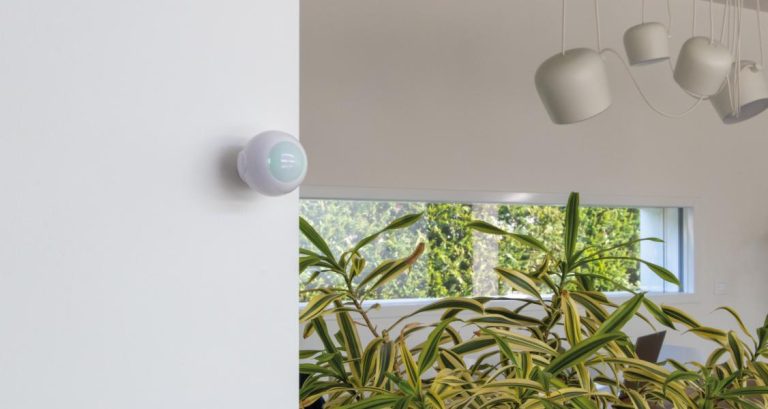
- Presence detection. A room empty for fifteen minutes switches to eco mode; when you come back, comfort returns before you even think about it.
- Scheduled setpoints. Cooler at night in the bedrooms, gentler during the day in the evening rooms, nothing where nobody goes.
- Solar coupling. More and more households are installing panels. The system shifts cooling toward the sunniest hours: the AC consumes when the panels produce, and eases off in the evening. You cool at the cost of your own kilowatt-hour rather than the grid’s.
- Centralized supervision. For villas and small hotel operations with several units, a single dashboard displays every AC, every contact, every temperature. An AC running in an empty rental stands out immediately, and the manager acts from their phone.
The Nice ecosystem (Yubii, Fibaro) does all of this in a single system. The same hub that controls your shutters, lights and gate also commands the AC, and it adapts to most brands without modifying your existing equipment.
In summary
Set it to 25-26°C. Run the ceiling fans. Clean the filters. Shade the condenser and the windows. Then let home automation do what discipline can’t sustain. Together, these measures typically reduce the cooling bill by 30 to 50%, with no real loss of comfort.
A free diagnostic from Nexus Carib
Nexus Carib works on the homes and villas of Saint-Martin every day: we know the rates, the salt and the heat. We install and configure Nice systems (Yubii, Fibaro), and we’ll tell you honestly if home automation isn’t worth it for your home. We’ll examine your installation, measure what your cooling really costs you, and hand you a list of actions ranked by savings, with no obligation. Contact us for a free diagnostic. 🌴