Constant heat and humidity: discover how a Nice Yubii connected home maintains thermal comfort in the Caribbean without sending your bill through the roof.
In Europe, they talk about heat waves. A peak, a few days, radio warnings, then back to normal.
In the Caribbean, there’s no return to normal. Heat is the normal. From May to November, the trade winds weaken, humidity climbs, and the home becomes a space you have to actively defend, day after day, for months.
The usual advice on the subject was written for a climate that isn’t ours. It talks about closing the shutters in the afternoon and airing the house at night. Here, the night air is heavy with humidity, and shutters left closed all day turn a room into a damp cellar.
The real challenge of thermal comfort in the Caribbean isn’t just temperature. It’s the balance between heat, humidity and ventilation. And it’s precisely the kind of balance a human being can’t maintain manually all day long.
What your home goes through while you’re away
It’s 1 p.m. No one is there.
The sun has been beating on the west façade for two hours. The heat passes through the sliding glass doors and builds up in the walls, floors and furniture. That thermal mass will keep releasing heat for hours, long after sunset.
When you get home at 6:30 p.m., it’s no longer about cooling the air. It’s about catching up with an entire house that heated up with no one to stop it. Your air conditioning goes into overdrive, runs at full power for two hours, and you still aren’t comfortable at 8 p.m.
That’s the daily scenario for most homes at our latitude. And it’s entirely avoidable.
Defend rather than catch up
The principle is simple: it costs far less to keep heat from entering than to remove it once it’s in.
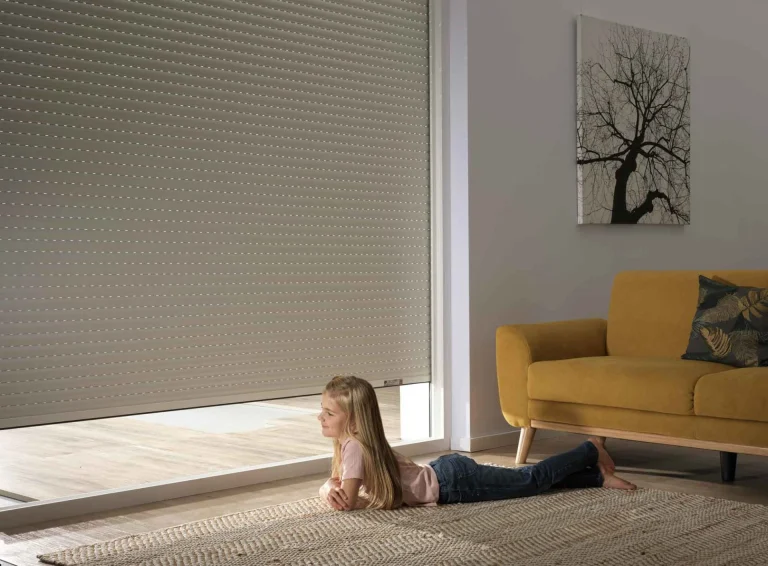
Solar shading that follows the sun
A connected home knows exactly which façade is exposed at which hour. Shutters and blinds gradually lower on the affected façade, then rise again as the sun moves on, while the other rooms stay open to light and view.
It’s not “close everything” or “open everything”. It’s a choreography that follows the sun’s path all day, room by room. No one can do that manually. An automated home does it without being asked.
Air conditioning that anticipates instead of catching up
Rather than starting abruptly when you get home, your system can gently lower the temperature in the late afternoon, while the load is still manageable. You walk into a home that’s already comfortable, and the air conditioning only has to maintain.
A system that maintains uses significantly less than a system that catches up. That’s true for the bill, and it’s true for the lifespan of your equipment.
Humidity, the variable everyone forgets
At 28°C with 55% humidity, you feel great. At 28°C with 85%, you can’t breathe. Same temperature.
Connected humidity sensors let your home trigger dehumidification or ventilation when the level drifts, not just when the thermometer rises. It’s often that adjustment that takes a room from “bearable” to “pleasant”, without ever touching the thermostat.
And beyond comfort, it’s also what protects your home: mold, odors, damage to furniture and joinery all begin with a humidity level left unchecked for too long.
Natural ventilation, used at the right moment
Our islands have a resource Europe doesn’t have: the trade winds. When they blow and the outdoor air is cooler than the indoor air, opening up beats air conditioning.
An equipped home can detect that moment and let you know. Use for free what the climate offers, before paying to manufacture it.
Comfort is not the enemy of savings
It’s the most stubborn received idea: to consume less, you’d have to accept being hotter.
In reality, the most comfortable homes during the hot season are often the ones with the lowest bills. Not because they deprive themselves, but because they work upstream instead of in emergency mode.
A home that blocks heat before it enters asks less of its air conditioning. An air conditioner that maintains rather than catches up consumes less. A home that manages its humidity is comfortable at a higher temperature, and every degree saved on the thermostat represents real savings.
Comfort and savings are not opposed. They are the same result, seen from two different angles.
A different hot season
The difference isn’t visible. It’s felt.
You come home and the house is already at the right temperature. You no longer get up to adjust a shutter or a thermostat. You no longer open the September bill with dread.
Your home spent the day taking care of it, while you took care of something else.
A certified [ART]IST can analyze your home’s orientation, its overheating hot spots and your habits, then suggest the automations that will have the most impact on your real comfort.