Here, the heat wave isn’t an event. It’s the season.

Confort thermique dans une maison connectée de la Caraïbe, volets Nice automatisés

Constant heat and humidity: discover how a Nice Yubii connected home maintains thermal comfort in the Caribbean without sending your bill through the roof.


In Europe, they talk about heat waves. A peak, a few days, radio warnings, then back to normal.


In the Caribbean, there’s no return to normal. Heat is the normal. From May to November, the trade winds weaken, humidity climbs, and the home becomes a space you have to actively defend, day after day, for months.


The usual advice on the subject was written for a climate that isn’t ours. It talks about closing the shutters in the afternoon and airing the house at night. Here, the night air is heavy with humidity, and shutters left closed all day turn a room into a damp cellar.


The real challenge of thermal comfort in the Caribbean isn’t just temperature. It’s the balance between heat, humidity and ventilation. And it’s precisely the kind of balance a human being can’t maintain manually all day long.


What your home goes through while you’re away


It’s 1 p.m. No one is there.


The sun has been beating on the west façade for two hours. The heat passes through the sliding glass doors and builds up in the walls, floors and furniture. That thermal mass will keep releasing heat for hours, long after sunset.


When you get home at 6:30 p.m., it’s no longer about cooling the air. It’s about catching up with an entire house that heated up with no one to stop it. Your air conditioning goes into overdrive, runs at full power for two hours, and you still aren’t comfortable at 8 p.m.


That’s the daily scenario for most homes at our latitude. And it’s entirely avoidable.


Defend rather than catch up

The principle is simple: it costs far less to keep heat from entering than to remove it once it’s in.


Solar shading that follows the sun

A connected home knows exactly which façade is exposed at which hour. Shutters and blinds gradually lower on the affected façade, then rise again as the sun moves on, while the other rooms stay open to light and view.

It’s not “close everything” or “open everything”. It’s a choreography that follows the sun’s path all day, room by room. No one can do that manually. An automated home does it without being asked.


Air conditioning that anticipates instead of catching up

Rather than starting abruptly when you get home, your system can gently lower the temperature in the late afternoon, while the load is still manageable. You walk into a home that’s already comfortable, and the air conditioning only has to maintain.

A system that maintains uses significantly less than a system that catches up. That’s true for the bill, and it’s true for the lifespan of your equipment.


Humidity, the variable everyone forgets

At 28°C with 55% humidity, you feel great. At 28°C with 85%, you can’t breathe. Same temperature.

Connected humidity sensors let your home trigger dehumidification or ventilation when the level drifts, not just when the thermometer rises. It’s often that adjustment that takes a room from “bearable” to “pleasant”, without ever touching the thermostat.

And beyond comfort, it’s also what protects your home: mold, odors, damage to furniture and joinery all begin with a humidity level left unchecked for too long.


Natural ventilation, used at the right moment

Our islands have a resource Europe doesn’t have: the trade winds. When they blow and the outdoor air is cooler than the indoor air, opening up beats air conditioning.

An equipped home can detect that moment and let you know. Use for free what the climate offers, before paying to manufacture it.


Comfort is not the enemy of savings


It’s the most stubborn received idea: to consume less, you’d have to accept being hotter.

In reality, the most comfortable homes during the hot season are often the ones with the lowest bills. Not because they deprive themselves, but because they work upstream instead of in emergency mode.

A home that blocks heat before it enters asks less of its air conditioning. An air conditioner that maintains rather than catches up consumes less. A home that manages its humidity is comfortable at a higher temperature, and every degree saved on the thermostat represents real savings.
Comfort and savings are not opposed. They are the same result, seen from two different angles.


A different hot season


The difference isn’t visible. It’s felt.
You come home and the house is already at the right temperature. You no longer get up to adjust a shutter or a thermostat. You no longer open the September bill with dread.

Your home spent the day taking care of it, while you took care of something else.

A certified [ART]IST can analyze your home’s orientation, its overheating hot spots and your habits, then suggest the automations that will have the most impact on your real comfort.

CCISM round table: Nexus Carib invited to speak on energy and building management

On July 16, the Chambre Consulaire Interprofessionnelle de Saint-Martin gathered three local energy players at its premises around a single question: what concrete solutions for businesses in the territory?

#NiceCarib was among the invited speakers, alongside Watt Sun SXM and Helios, to represent the automation and building management side.


A round table born of a simple observation

In Saint-Martin, electricity is still overwhelmingly carbon-based, and its cost weighs directly on business competitiveness. That’s no secret to any business leader on the island.

As part of its support program for businesses in their energy and environmental transition, the CCISM wanted to give professionals concrete reference points rather than general principles. Where to start. Which solutions actually exist in the territory. At what cost. With what measurable benefits.

The format was deliberately direct: three speakers, ninety minutes of discussion, then open networking time with the audience.


Producing and managing: two trades, one equation

The speakers’ complementarity was no coincidence.

Watt Sun SXM and Helios covered the production side — photovoltaics, solar solutions adapted to local constraints. #NiceCarib brought the management side — automation of shutters, lighting, air conditioning and access, plus real-time consumption metering.

It was precisely the connection between these two worlds that fueled the most interesting exchanges of the evening.

Producing your own electricity is an excellent investment at our latitude. But a solar installation doesn’t decide when your water heater kicks in, or whether your air conditioning runs in empty offices at the weekend. This gap between production hours and consumption hours remains the blind spot of many installations.

Managing your building is what allows the energy you produce to actually be used — and the energy you buy to stop being wasted.


The questions that kept coming back

The exchanges with the audience confirmed that the barriers to investment are clearly identified by local businesses — and that they are legitimate.

The entry cost. The budget question came up quickly, and that’s only natural. The answer lies less in a single figure than in a step-by-step logic: start with the most impactful items, measure, then expand.

Hurricane constraints. A specifically local concern that no one in Saint-Martin can wave away. It shapes equipment choices just as much as the budget.

Return on investment and financing. How long to pay it back. Which schemes can be tapped. This is arguably the topic on which businesses need the most support — and one of the roles the CCISM usefully plays through this program.


What we take away from it

The caliber of the questions confirmed something we’ve been observing for several months: businesses in Saint-Martin no longer wonder whether the energy transition concerns them. They are looking for applicable, quantified solutions adapted to their reality.

That’s a notable shift. And it’s precisely the ground on which #NiceCarib wants to be useful.

Thanks to the CCISM’s Engineering Unit for the organization and the quality of the setting. Thanks also to Watt Sun SXM and Helios for exchanges that showed these solutions are best designed together rather than in isolation.


Were you at the round table and would you like to go deeper on energy management for your business? We’re available to talk about it, with no obligation.

? Contact us →
? Find a certified [ART]IST →

You produce by day. You consume in the evening. That’s where it gets stuck.

You’ve taken the leap. Panels installed, inverter in place, production starting at sunrise.

And then you look at your numbers. Your production is great. Your habits, on the other hand, haven’t budged an inch.

This isn’t an anomaly. It’s the blind spot of most residential photovoltaic installations: solar takes care of producing. Nobody takes care of consuming at the right time.


The gap no one explained to you

Your solar production follows a simple curve. It starts around 7 a.m., peaks between 11 a.m. and 3 p.m., and collapses in the late afternoon.

Your consumption, on the other hand, follows exactly the opposite pattern. Low during the day when the house is empty. It explodes between 6 p.m. and 10 p.m. — air conditioning on full blast, lights everywhere, the water heater kicking back in, the kitchen in full swing.

The result is almost absurd: you produce massively at the very hours you consume least, and you consume massively at the hours you no longer produce.

All the energy you produce during the day but don’t use goes back to the grid — often sold at a rate well below what you’ll pay to buy it back in the evening. And every kilowatt-hour consumed after sunset is purchased at full price.

In the Caribbean, where electricity rates are structurally high, this gap weighs heavily on your real profitability.


What home automation changes in the equation

The principle is simple: instead of letting your home consume at the whim of your habits, you shift whatever can be shifted into your production hours.

This is what’s called managed self-consumption. And it’s exactly the role of the Nice Yubii ecosystem.

The water heater, moved into full sunlight
This is the most immediate lever. A water heater accounts for a significant share of your consumption, and it doesn’t care one bit what time it heats — as long as the water is hot when you need it. Scheduled to run between 11 a.m. and 3 p.m., it operates almost for free on your own production.

Air conditioning, pre-cooled before you get home
Instead of starting at full power at 6 p.m., when you’re no longer producing, your system can lower the temperature in the late afternoon while the sun is still shining. The house is cool when you arrive, and the air conditioning only has to maintain — not catch up.

Solar shading that lightens the load
Motorized shutters and blinds driven by sunlight directly reduce incoming heat. Less heat, less work for the air conditioning, fewer kilowatt-hours to cover. Your solar production then covers a far greater share of your real needs.

Heavy consumers, triggered at the right time
Washing machine, pool pump, filtration — anything that can run on a delayed schedule can be programmed into your production hours instead of your purchase hours.


See, so you can act

None of this works well in the dark.

That’s where connected metering modules come in. By seeing in real time what your installation produces and what each appliance consumes, you stop managing by feel.

You see the gap. You see which appliance really weighs on the bill. You see the immediate effect of every adjustment. And you can fine-tune your automations month after month, based on the seasons and your actual usage.

A solar installation without consumption monitoring is a dashboard with no speedometer. It moves forward — but you don’t know how fast.


Solar and home automation are not competitors

That’s the message we’d like to make clear.

Photovoltaics are an excellent investment in the Caribbean. Our sunshine is one of the greatest natural assets of our islands, and it would be absurd not to harness it.

But producing energy and using it well are two different trades. Solar answers the first question. Home automation answers the second.

Together, they form a coherent system: a home that produces intelligently and consumes at the times when it costs the least.

Apart, each leaves part of its potential untapped.


If you’re already equipped with solar

Good news: you don’t have to redo anything.

The Nice Yubii ecosystem adds on to your existing installation. It doesn’t replace your panels, your inverter or your production system. It manages what happens after the meter — in other words, everything your photovoltaic installer couldn’t handle.

A certified [ART]IST can analyze your production and consumption profile, then identify the automations that will have the most impact on your self-consumption.

You invested in production. Now invest in how it’s used.

Home automation for business: what your energy costs really add up to

In the Caribbean, businesses pay more for electricity than almost anywhere else. It’s a structural reality every business leader knows — and that most have come to accept as inevitable.

It isn’t.

Energy costs for an office or retail business average between 20% and 30% of fixed operating expenses. That’s a major line item — and it’s precisely where professional home automation delivers its fastest return on investment. But it does more than shrink a bill: it also protects your operation against losses no energy saving could ever offset.

The problem nobody really measures

Most business leaders know their rent to the euro. Very few know their energy consumption by item, by zone, by hour of the day.

That’s normal — without a measurement tool, it’s impossible to see. But that’s also exactly where the lost money hides.

The air conditioning running all weekend because nobody thought to switch it off when they left Friday night. The storage areas and corridors lit around the clock, even when nobody walks through them. Devices on standby drawing power 24/7. Missing blinds or shutters that let the sun heat the premises and force the AC to compensate.

Each item seems harmless on its own. Together, they represent thousands of euros a year slipping away unnoticed.

What Nice Yubii home automation changes in practice

Smart air conditioning by zone and schedule

Your system detects presence in every space and adjusts the air conditioning accordingly. Empty meeting room — AC reduced automatically. Last person leaves — everything switches off. No more weekends spent air-conditioning a ghost office.

Time-based scheduling also lets you align your consumption with your real hours of activity — rather than a fixed setting that ignores your closing days, public holidays, and seasonal patterns.

Presence-detected lighting

Corridors, restrooms, storage areas, parking lots — these spaces make up a significant share of your floor area but are only used a fraction of the day. Presence-detected lighting only comes on when someone is there. Not before. Not after.

In a mid-sized retail business, this single measure can represent 15% to 20% savings on the annual lighting bill.

Automatic solar protection management

Blinds or shutters managed properly according to orientation and sunlight directly reduce the heat entering your premises. Less heat coming in — less work for your air conditioning — lower consumption. It’s a simple virtuous circle, but you need a system to truly automate it.

Real-time metering — see before you act

You can never properly reduce what you don’t measure.

That’s the missing link in most businesses: nobody knows precisely what the showroom’s air conditioning consumes compared to the stockroom lighting, or what the IT server running 24/7 represents compared to everything else.

With connected metering plugs and modules (smart power meter), every appliance or circuit becomes individually visible. You see live, from your phone:

  • Your establishment’s overall consumption, in real time
  • The consumption of each appliance or zone taken separately — air conditioner, lighting, commercial refrigerator, server, coffee machine
  • How that consumption changes depending on the mode used — AC in eco mode versus comfort mode, lighting at full intensity versus reduced intensity

It’s this granularity that changes everything. You no longer guess where your money goes. You see it, appliance by appliance, and you can act precisely where it counts — instead of optimizing blind.

Many business leaders discover, once equipped, that a single misconfigured appliance accounted for 30% of what they thought was “normal, unavoidable” consumption. Without metering, that discovery never happens.

Remote control and supervision

From your phone, from anywhere, you see what your establishment is consuming in real time. You can intervene, cut power, adjust — without having to travel there. And if something abnormal happens outside opening hours, you’re alerted immediately.

Beyond energy: prevention that averts disasters

Cutting your bill is important. Avoiding a total loss in a single night is vital.

In the Caribbean, where power cuts and voltage fluctuations are more frequent than elsewhere, some sensors don’t just save money — they protect your operation against losses no energy saving could ever offset.

Temperature sensors for cold rooms and refrigerators

For a restaurant, caterer or food business, a cold room drifting a few degrees overnight can mean the loss of several thousand euros’ worth of stock by morning — with no physical alarm going off to warn you in time.

A connected temperature sensor continuously monitors every cold unit. If the temperature leaves the normal range — compressor failure, a door left ajar, a prolonged power outage — you receive an immediate alert on your phone, wherever you are. You have time to act before the loss becomes total.

For a restaurant that depends on its cold room to operate, this sensor can potentially pay for itself in a single avoided night.

Level sensors for cisterns and water reserves

On an island where water is a carefully managed resource, knowing exactly where your cistern level stands avoids two costly problems: running dry in the middle of operations, and overflow that wastes a precious resource and needlessly bills a refill.

A connected level sensor gives you a real-time reading and alerts you before shortage or overflow — letting you schedule a water delivery or adjust your consumption before it becomes an operational problem.

Water leak detectors

An undetected leak over a closed weekend can turn a business into a repair site by Monday morning — damaged floors, destroyed stock, forced closure during the works.

A leak detector placed at the sensitive points — under a sink, near a water heater, in a stockroom — detects the slightest abnormal presence of water and triggers an instant alert. Some systems can even shut off the main water supply automatically to limit the damage before a human intervenes.

And other useful sensors depending on your business

The Yubii ecosystem expands according to your real needs:

  • Air quality and humidity sensors — useful for businesses sensitive to storage conditions (wine cellar, textile storage, pharmacy)
  • Door and window opening sensors — security after closing hours, but also an alert if a cold room is left open too long
  • Connected smoke and carbon monoxide detectors — immediate alert even at a distance, not just a local audible signal
  • Vibration or motion sensors — useful for monitoring sensitive equipment or secondary access points

Every sensor added is one less risk to manage manually — and one potential disaster avoided.

Calculating the return on investment

Let’s take a concrete example for a mid-sized retail business or office in the Caribbean.

Average monthly energy costs: €800 to €1,500
Savings observed with full home automation: 20% to 35%
Estimated monthly savings: €160 to €525
Estimated annual savings: €1,900 to €6,300

A professional Nice Yubii installation suited to this type of premises is an investment that typically pays for itself within 18 to 36 months — depending on the equipment level and your starting consumption.

Businesses equipped with individual metering sensors identify an average of 2 to 3 unsuspected over-consumption items within the first 3 months — often accounting for 10% to 15% of the total bill on their own.

And beyond energy savings, sensor-based prevention can avoid one-off losses far greater than the cumulative annual savings: an undetected cold room failure, a water leak during a closure, or a cistern running dry mid-operation all represent immediate costs that preventive home automation helps avoid.

Beyond the payback point, every subsequent year is a net reduction in costs — and every avoided incident is a loss that never happened.

Beyond savings: what it changes for your business

Your image with your clients

An office or retail space equipped with professional home automation sends an immediate signal: this is a serious, modern, well-organized business. In sectors where trust and credibility are assets, that signal has value.

Your management comfort

No more calling an employee to check whether the lights are off or the cold room is holding its temperature. No more Monday-morning discoveries that the AC ran all weekend, or worse, that a leak flooded the stockroom. No more managing access to the premises with physical keys that get lost or duplicated. That’s reclaimed mental bandwidth — and less stress.

Your appeal as an employer

A smart, well-managed work environment contributes to your teams’ daily comfort. It’s a detail that matters — especially in island markets where talent has choices.

Where to start

No need to do everything at once. The most effective approach is progressive:

Start with lighting, air conditioning and consumption metering — the most impactful items with the fastest payback in a Caribbean office or retail business. Then add prevention sensors (temperature, leak, level) according to the risks specific to your activity — essential for a restaurant or food business, valuable for any professional premises.

A certified Nexus Carib [ART]IST can audit your current installation and propose a phased equipment plan — with a savings estimate for each stage.

The best investment you make this year may not be in your inventory or your marketing. It will be in your electricity consumption — and in what it keeps you from losing.

Your villa is worth more than you think. Home automation proves it.

We often talk about home automation in terms of comfort. Security. Energy savings.

We rarely talk about what it does to the value of your property.

Yet it’s one of the strongest — and least used — arguments for a property owner in the Caribbean.

Today’s buyer is no longer the same

Ten years ago, a villa buyer in Saint-Martin, Saint-Barth or Guadeloupe was looking for a view, a pool, square footage.

Today, that same buyer arrives with international references. They’ve stayed in hotels where the shutters close automatically at sunset. They’ve rented villas where access is keyless. They may live in a connected home in Europe or the United States.

When they tour your property, they no longer just see square meters. They’re evaluating a lifestyle.

And a villa equipped with a complete home automation system can no longer be compared to a standard villa. It plays in a different league.

What the numbers say

Real-estate studies conducted in Europe and North America all point the same way: a home equipped with home automation sells on average 5% to 15% higher than a comparable unequipped property — and sells faster.

In the Caribbean’s high-end segment, where buyers are often international and discerning, the gap can be even wider. That’s not a sales pitch. It’s a market reality that specialized real-estate agents are seeing more and more.

A Nice motorized gate. Automated shutters. An integrated security system. A Tedee smart lock. These are features that can be seen, felt, and priced into the transaction.

Home automation as a negotiating argument

In a real-estate sale, anything that removes the buyer’s objections strengthens your negotiating position.

A buyer touring an automated villa doesn’t have to imagine future integration work. They don’t have to wonder how to manage the property remotely from Paris or New York. They don’t have to plan for the cost of an installation after purchase.

It’s already done. It’s already there. And it works.

That peace of mind has a value — and serious buyers recognize it immediately.

What about vacation rentals?

If your villa generates rental income, the equation is even more direct.

Premium rental platforms — and agencies specializing in luxury villas — now list home automation features as ranking and pricing criteria. A connected villa justifies a higher nightly rate. It earns better reviews. It builds loyalty among demanding guests who will come back.

The return on investment of a Nice Yubii installation isn’t measured only on your electricity bill. It’s also measured in your occupancy rate and your average nightly rate.

Invest now, add value later

Installing a complete home automation system is an investment. But unlike a renovated kitchen or a remodeled bathroom, this investment is visible, demonstrable and measurable by any potential buyer or tenant.

And in a Caribbean market moving upmarket — driven by an increasingly sophisticated international clientele — being equipped before everyone else means building a lead your neighbours will take years to catch up on.

The question isn’t “is it worth it?”

The question is “can I afford not to do it?”


A certified [ART]IST can propose an equipment plan tailored to your property — whether it’s a primary residence, a second home or a vacation rental.

Hurricane season: what your smart home can do before, during and after

In Saint-Martin, nobody needs to explain what a hurricane can do. We know. We’ve lived it. We’ve rebuilt.

And every year, between June and November, the same question comes back: is my home really ready?

Are the shutters properly closed? The gates locked? The electrical systems protected? Have I thought of everything — from an airport 3,000 kilometres away, with a phone and an unstable connection?

Home automation doesn’t perform miracles. It can’t withstand 300 km/h winds. But it does something just as precious: it gives you control when everything else spirals out of control.


Before — Prepare in a few gestures

Hurricane preparation is often a race against the clock. The alerts come in, everyone mobilizes at once, and something always gets forgotten.

With a Nice Yubii home automation system, preparation becomes a single scene. One tap on your phone — from your living room or from the other side of the Atlantic — and your home switches into protection mode:

Shutters closed and locked on every opening simultaneously. No room-by-room walkthrough. Everything closes with a single command.

Gate and access points secured automatically. No more risk of a poorly closed gate flying off in the wind.

Outdoor lighting switched off to avoid overloading a fragile power grid.

Alerts configured so you’re notified in real time of any change in your home’s status — a detected opening, a triggered sensor.

What used to take an hour of manual checks becomes a 30-second action.


During — Monitor from anywhere

This is often when the anxiety is at its worst. You’ve evacuated. You’re waiting. And you have no idea what’s happening at home.

The Hikvision cameras connected to your system give you a real-time window onto your property — as long as the connection holds. You see. You know. You don’t endure the wait in total darkness.

And if something unlocks, if an opening is detected, if a sensor triggers — you get an immediate alert on your phone.

Distance doesn’t erase worry. But it’s infinitely more bearable when you have eyes on your home.


After — Regain control quickly

The aftermath is often the hardest phase to manage logistically. Roads are cut off. Access is difficult. And sometimes you need to send someone to check on your property before you can get back yourself.

With Tedee, your smart lock lets you open your home remotely — for your property manager, a trusted friend, an emergency repair company — without handing over a physical key. You control who enters, when, and for how long.

Your property stays under your control even when you’re not there to manage it in person.


What home automation doesn’t do

Let’s be clear.

No home automation system can withstand Irma. Nice motorized shutters are robust — but against a Category 5 wind, no equipment is invulnerable.

What home automation offers you is something else: the certainty of having done everything possible. The peace of mind of knowing your home was as prepared as it could be. And the ability to monitor, act and regain control faster than anyone else.

On an island that has learned to rise again, that’s already a lot.

Prepare your home before tomorrow

Hurricane season starts June 1. The best time to install an automated protection system is now — not when the first alert drops.

A certified [ART]IST can assess your current setup and recommend the most relevant automations for your type of property.

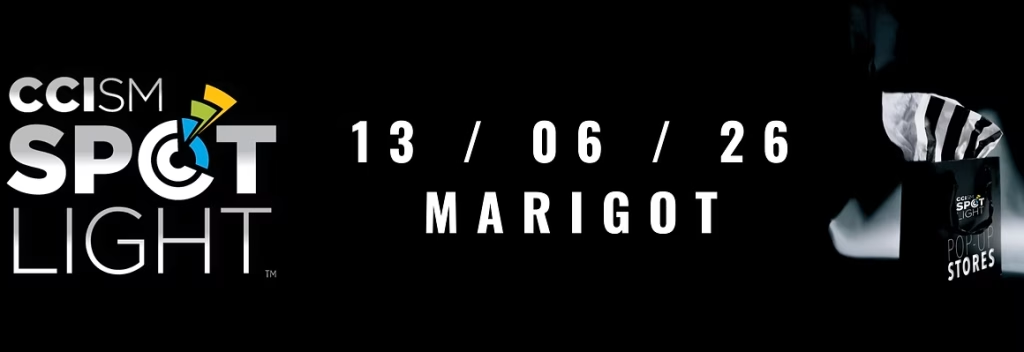
#NiceCarib at the CCI of Saint-Martin Spotlight — come discover the home of tomorrow

On June 13, 2026 in Marigot, we will be at the CCI of Saint-Martin Spotlight. A rare opportunity to see live what technology can do for your living space.


June 13, 2026 · Spotlight CCI · Marigot, Saint-Martin


There are encounters that can’t be explained — they have to be experienced. That’s exactly the mindset we’re bringing to the CCI of Saint-Martin Spotlight.

#NiceCarib will be there.

And we can’t wait to meet you there.


Why the Spotlight

The CCI of Saint-Martin Spotlight is the event where the local economy shines at its best. Entrepreneurs, decision-makers, architects, developers, hospitality and real-estate professionals — all gathered in one place for one evening.

That’s exactly #NiceCarib’s territory.

Since our launch, we’ve been working behind the scenes — selecting our brands, training our partners, building our vision. The Spotlight is our first public event on the island. And we didn’t want to miss it.


What you’ll discover

Not a booth with brochures and pens bearing our logo.

We’ll be there to talk — really talk — about what technology can do for your villa, your real-estate project, your hotel, your rental property. About how a gate that opens on its own, a light that anticipates, a camera that recognizes can turn an ordinary property into an extraordinary experience.

We’ll talk about Nice, Hikvision, Tedee, ELAN. Not as products to sell — but as tools to understand, to imagine, to desire.

And if you’re an electrician, installer or integrator — we’ll also talk about the [ART]IST Academy. About the program we’re building to train and select the Caribbean’s elite integrators. Maybe your island is waiting for you.


A complimentary consultation on site

For every owner, architect or developer who visits us at the Spotlight, we’re offering a 20-minute consultation — on site, informal, no obligation.

You describe your project. We tell you what’s possible, what’s relevant, what would truly make a difference. Not a sales pitch — an expert conversation.

Spaces are limited. If you’d like to reserve your slot before the event, contact us directly.


See you at the Spotlight

Join us on June 13, 2026 in Marigot. We’ll be easy to find. Look for the team talking about homes that think, gates that know who you are, and sound that comes from the ceiling.

Or simply look for #NiceCarib.

See you very soon.